|

The Fire Service has
evolved significantly since the days of bucket brigades, as our
job no longer involves simply putting the wet stuff on the
red stuff. Today's modern firefighter must be knowledgeable
and proficient at handling a wide-spectrum of emergency
situations and the challenges they present. To help us complete
these difficult tasks, many different types of tools and
equipment are utilized, some of which have been developed
specifically for use in the fire service.
While there are many
tools of the trade in the fire service, we have chosen some of
the more prominent items which we use frequently in our duties.
On this page you can learn about our protective clothing
including our helmets, the
self-contained breathing apparatus, the axe
and Halligan, the
thermal imaging camera, various
extrication tools, and how and when we use these items.

 |
| |
Typical
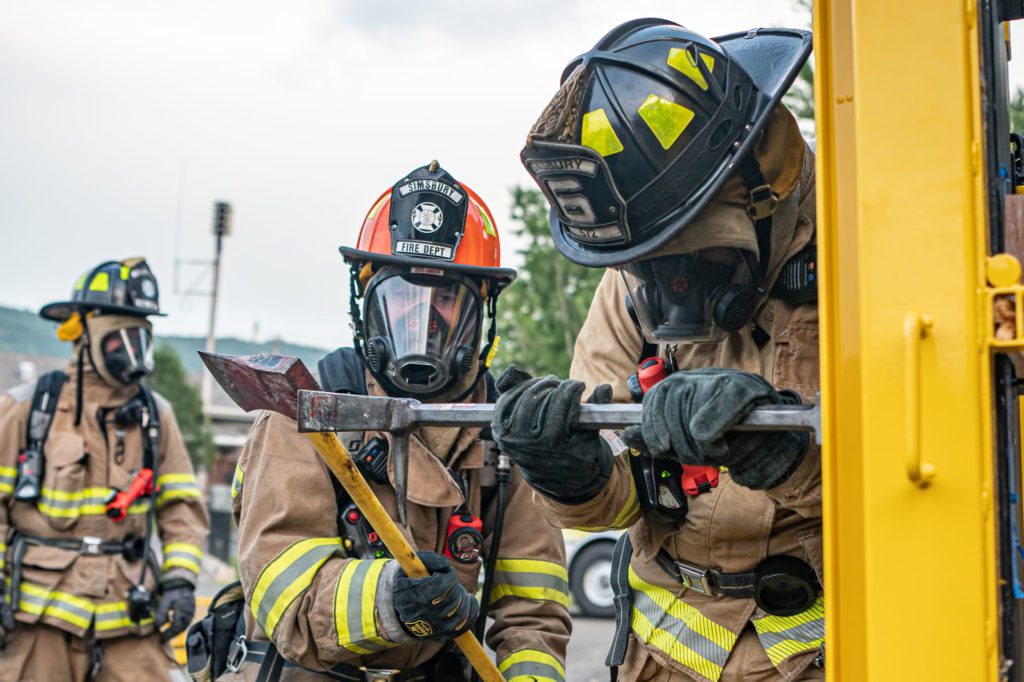
personal protective equipment consisting of turnout
gear, helmet, hood, gloves, boots and SCBA. |
Without a doubt, no
equipment is more important than the gear which is used to
protect firefighters from the many hazards they confront. Dependant
upon the nature of the emergency incident, firefighters always
utilize some level of Personal Protective Equipment to
help shield themselves from injury. Personal Protective
Equipment refers to any clothing, helmets and equipment,
such as self-contained breathing apparatus, which is worn to
protect firefighters from injury.
The coat and pants
used for structural firefighting are commonly referred to as
Bunker Gear or Turnout Gear, and are designed to
protect the wearer from the hazards of fighting fires and other
dangers that may be encountered.
National Fire Protection
Association standards require all turnout coats and pants to
incorporate three protective components: an outer shell, a
moisture barrier and a thermal barrier.
 |
|
The
outer shell and inner liner of a turnout coat. |
|
Dependant upon the
properties of the material it is constructed from, the outer
shell can offer many protections. Its first and foremost job is
to protect the firefighter from injury due to direct contact
with flames and heat. The fabric of the outer shell also helps
to protect against cuts and abrasions and may provide a limited
amount of water repellency.
 |
| |
Reflective trim is designed to be highly visible
even in poor lighting conditions. |
The moisture barrier
and thermal barrier are usually incorporated into a common liner
which fastens to the inside of the outer shell. The moisture
barrier serves to keep water, steam, blood and vapors from
entering and making contact with the firefighter while still
allowing heat and perspiration to be released. The thermal
component of the liner must also allow moisture to be expelled,
but its primary job is to protect the wearer from high levels
of heat.
A fourth component
that is required for all turnout gear is reflective trim which
helps to provide visibility and identification under many
conditions. Turnout trim usually incorporates a fluorescent
component for daytime visibility and a reflective component to
catch light during nighttime and low visibility conditions such
as a smoke-filled room. Different color trim is usually utilized
to help easily differentiate firefighters from officers.

 |
| |
Today's
modern fire helmets provide protection against many
hazards. Flip-down eye shields however, are not
considered adequate eye protection. |
Like turnout gear,
helmets are designed to provide the firefighter with many
protections. The primary function of any helmet used in the fire
service is to provide impact protection to the head. Helmets
designed for structural firefighting also provide protection
against heat with their liners and earflaps. The brim of a
structural helmet should prevent water and embers from finding
their way inside the coat around the neck.
 |
|
An early
era fire helmet with front piece is depicted in this
Currier & Ives lithograph from 1858 entitled "The
American Fireman - Facing the Conflict." |
|
Many structural
helmets have some sort of eye or face protection incorporated
into them that can be lowered into position when needed. These
devices serve only as secondary protection and do not negate the
need for wearing approved, primary eye protection such as
goggles or safety glasses when the situation requires them.
While modern fire
helmets are generally constructed of composite materials and
come in many different models, the classic shape of the fire
helmet dates back to 1836 when it was constructed of durable
leather. Today, both composite and leather models of the classic
shape are available. Regardless of construction, all helmets
must be designed to meet the same National Fire Protection
Association standard.
The creation of that
leather helmet in 1836 is credited to Henry T. Gratacap, who
owned a business producing ocean transit luggage from specially
treated leather that offered superior durability and withstood
wetness without rotting1. Being a volunteer
firefighter in New York City, he was aware of firefighter's need
for better head protection, so H. T. Gratacap developed a helmet
and named it the "New Yorker."
Shortly thereafter,
two brothers named Cairns who operated a Metal Badge, Button,
and Insignia business in New York, came up with the idea to
mount an identification badge to the front of Gratacap's
helmets. Hence the first front piece (or shield) and holder were
born. The two companies cooperated until H. T. Gratacap's
retirement in the mid 1850's, and the Cairns & Brother legacy of
fire helmets began. Although the New Yorker has been
re-engineered throughout its lifetime, it is still produced
today by CairnsHelmets, a division of Mine Safety Appliance Co.
(MSA).
The use of the eagle
on the helmet as a holder for the shield has an equally long
history. Around 1825, an unknown sculptor did a commemorative
figure for the grave of a volunteer fireman in Trinity
Churchyard in New York City2. It depicted the hero
issuing from the flames, his trumpet in one hand, a sleeping
babe in the other, and, on his hat, an eagle. No firefighters
were wearing eagles at the time as it was a flight of pure fancy
on the sculptor's part, but as soon as the firemen saw it they
thought it was a splendid idea, and since every fire company in
those days designed their own uniforms, it was widely adopted at
once.
 |
|
Illustration depicting a high eagle. |
|
The eagle has
remained on fire helmets ever since, in spite of the fact that
it has frequently proven to be a dangerous ornament. The older
style of the eagle as a shield holder sat much higher than its
modern-day counterparts, hence the name "high eagle." Its beak
caught on window sashes, wires and everything else. It was
always getting dented, bent and knocked off. Every so often some
realist would point out how much safer it would be to do away
with the eagle, but traditionalists always refused. Today, the
eagle, and other styles of shield holders, sit much lower on the
helmet, but they still manage to catch on things and get dented
just as their predecessors did.
A firefighter's
helmet is a very personal item, and as unique as the individual.
While most departments issue helmets made from a composite
material because of their lower cost and weight, many
firefighters choose to purchase their own leather helmet out of
love for one of the fire service's oldest traditions.
A casual observation
of a helmet may tell you much about the firefighter, and maybe
even a little about the person. The color of the helmet usually
signifies the rank of the firefighter as Chief's helmets are
almost always white. In Simsbury, a red helmet denotes a
Junior Firefighter whereas regular
firefighters, Lieutenants and Captains wear black. Usually you
can find many decorations on a fire helmet, commonly in the form
of decals. American flags, shamrocks and memorials to fallen
firefighters are all very common. Sometimes you can also learn
about some of the firefighter's qualifications such as if they
are an engineer for an apparatus, and what level of hazardous
materials or medical training they have.
Not surprisingly,
many of the firefighters who choose to buy their own helmet also
buy a custom shield for it. Shields also can indicate many
things including rank, station, service number and organization
or municipality. Click on the picture above to see the many
different helmets which have been worn by the members of the Simsbury
Volunteer Fire Company through the years.
1 Excerpts on the history of the leather helmet used with
permission from Mine Safety Appliance Co.
2 Excerpts on the history regarding the eagle adapted from
The New Yorker Magazine, June 14, 1930


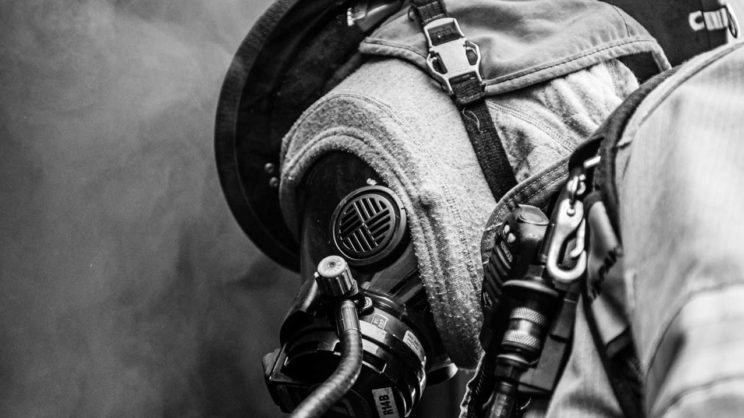
The Self-Contained
Breathing Apparatus is another essential component of a
firefighter's Personal Protective Equipment as it
provides crucial protection to the user's lungs, respiratory
tract, eyes and face. Without its protection, a firefighter
could be seriously injured and quickly incapacitated from
dangerous atmospheric conditions such as oxygen deficiency,
elevated air temperatures, smoke and other toxic components.
Its use is mandatory anytime a firefighter might encounter a
hazardous atmosphere such as while fighting a fire,
investigating for carbon monoxide, operating at a hazardous
materials incident or performing a below-grade rescue.
 |
|
SCBA
harness with attached air cylinder. |
|
The SCBA provides
clean, breathable air to the user from a cylinder of compressed
air which is attached to the SCBA harness and worn on the
firefighter's back. Contrary to a very popular belief,
firefighters do not carry oxygen in their bottles. It is simply
the normal everyday air that we all breathe which has been
filtered and compressed
for SCBA use.
When the firefighter
inhales, a negative pressure is created inside their facepiece
which the regulator senses thus triggering air flow. The
high-pressure air travels from the cylinder to the pressure
reducer where it is reduced to a pressure slightly greater than
atmospheric pressure (14.7 psi), and is then delivered to the
facepiece for inhalation. When the firefighter ceases their
inhalation, the regulator detects this and stops the flow of air
to the mask.
Even after air flow
to the mask stops, the pressure inside the facepiece remains
slightly greater than the atmospheric pressure on the outside.
Known as positive pressure, this guarantees that should the
facepiece develop a leak or become slightly dislodged, air will
flow out of the facepiece and prevent any contaminated
atmosphere from entering in.
 |
| |
The
Scott Air-Pak Fifty 4.5 Self-Contained Breathing
Apparatus with facepiece, carbon fiber cylinder and
integrated Pak-Alert SE Personal Alert Safety
System. |
In 1997, the
Simsbury Volunteer Fire Company formed a committee with the
mission of exploring replacement of our aging Scott 2A SCBA's.
After an intensive investigation including hands-on testing of
all major manufacturers' products, a recommendation was made to
the Fire District to purchase the Scott Air-Pak
Fifty 4.5 Self-Contained Breathing Apparatus. The Scott Fifty's
offered many advantages and several add-on safety features were
chosen when the air packs were purchased.
Probably the most
notable attribute of the Scott Fifty SCBA is its weight, or
lack thereof. By using the 4,500 psi carbon fiber cylinder which
is rated for 30 minutes of work time, the entire SCBA weighs-in
at just over 18 pounds. These lighter-weight packs help to
reduce firefighter fatigue and injuries. While the
weight-reduction provided by the carbon fiber bottles is a great
advantage, extra care must be afforded to them because of their
specialized construction.
 |
 |
|
|
Cutaway
of a Scott carbon fiber cylinder, and a close-up of
damage resulting from the dragging of a cylinder
across a concrete floor during a training evolution. |
|
These cylinders
consist of an aluminum alloy inner shell, with a total over wrap
of carbon fiber, fiberglass and epoxy resin. The over wrap is
not as durable as metal cylinders and excessive wear of the over
wrap can force the cylinder to be taken permanently
out-of-service.
Simsbury's SCBA's
are equipped with the Emergency Buddy Breathing System. By use
of a quick-disconnect in the low pressure line between the
pressure reducer and the mask-mounted regulator, a firefighter
experiencing either a malfunction or low air condition can connect their regulator
to another SCBA. A supplied airline accessory also allows the
SCBA to be supplied from a remote low pressure source providing
virtually unlimited service time.
Tower 12's
platform has
supplied air connections for this purpose.
 |
| |
Two
firefighters can simultaneously breath from the same
air cylinder with the Emergency Buddy Breathing
System. |
For optimal
firefighter safety, Simsbury chose to equip their Scott Fifty's
with the Pak-Alert SE integrated Personal Alert Safety System.
Firefighters are required to utilize PASS devices anytime their
duties require a SCBA. Unlike stand-alone PASS devices which
require the firefighter to physically switch them on for use,
the Pak-Alert SE turns on when the firefighter opens their SCBA
cylinder for use, negating the need to turn the PASS on manually
and safeguarding against the danger of forgetting to do so.
 |
|
Integrated PASS
device with air supply gauge. |
|
Through their
audible and visual warning signals, PASS devices assist rescuers
in locating firefighters in distress. The PASS device functions
by sensing motion. Should the firefighter become motionless,
after approximately 30 seconds the PASS will begin to emit a
loud, shrieking alarm accompanied by a pulsating light.
Firefighters who become trapped or disoriented can also activate
their device manually.
 |
| |
SCBA
maintenance and repair shop. |
|
Simply put, self-contained breathing
apparatus are essential and we couldn't perform our duties
without them. Recognizing this, the Fire District stipulated in
the purchasing contract that we become a Scott-authorized
in-house repair facility, certified to perform all levels of
repair up to and including full overhaul. For a volunteer
department this is a unique capability and has proven to be a
significant cost savings to the Fire District, especially since
OSHA has mandated annual flow testing of all SCBA's.
 |
|
A SCBA
being tested on the Biosystems Posi-3 dynamic test
stand (L), and the Scott test bench (R). |
|
Located at the
Weatogue Station, the SCBA maintenance and repair
shop is equipped with a Scott test bench, a Biosystems Posi-3
dynamic test stand, and tools and spare parts. Except for
hydrostatic testing of the air cylinders which is completed by
a third-party vendor, virtually all SCBA maintenance and testing is
performed by three firefighters who have received factory
training. This in-house ability provides an additional
advantage of significantly decreasing the down-time when a unit
must be taken offline for maintenance and repair.


 |
| |
A
"married" set of "Irons." |
The flat-head axe
and the Halligan Bar are undoubtedly the two most-used hand tools in
the fire service as they are utilized in a wide-variety of
applications. They can be found on most apparatus and are
commonly carried paired-together with the fork-end of the
Halligan fitted over the head of the axe, and the two handles
secured to each other with some kind of fastener. When carried
together in this manner they are commonly referred to as "The
Irons" and are said to be "married."
The flat-head axe
serves as both a cutting tool and a striking tool, and has many
useful purposes. The flat-head axe can be used to cut holes in
walls, doors, floors, roofs and even laminated automotive
windshields during extrication operations. As a striking tool,
it is commonly used drive the Halligan and other prying tools
for forcible entry operations.
 |
 |
|
|
Useful
for a wide-variety of applications, the Halligan Bar
is commonly used for forcible entry. |
|
The Halligan Bar or
Halligan Tool, is a multipurpose prying tool which was designed
in the 1940's by Hugh Halligan, a First Deputy Fire Commissioner
in the
New York City Fire Department. One end of the bar contains
the fork, which is commonly used to force inward swinging doors.
The other end of the Halligan consists of the adze and the pick.
The adze is useful for forcing outward swinging doors. The pick
can be used for punching the locks out of automobile doors and
trunks, and it can be inserted into the shackle opening of a
padlock, and then struck with an axe or sledge hammer to break the
shackle free from the lock.
| |
 |
 |
| |
The
Halligan Bar being used to create anchor points. |
The Halligan can
also be driven into the ground to created anchor points, such as
to keep a master stream device from creeping. In the absence of
a bombproof anchor, the Halligan can also be used in conjunction
with other pry bars and webbing to create an anchor point for
high-angle rescue called a "picket system".
The axe and Halligan
are carried together because the are so often used in
conjunction with one another. Anytime the Halligan is needed for
forcible entry, the flat-head axe is used to drive the Halligan
into the opening.
|
 |
 |
|
|
The
flat-head axe and Halligan Bar being used to create
a "purchase point" in a vehicle door so that the
hydraulic spreaders can be inserted to pry the door
from the Nader Bolt. |
|
Search and rescue
teams often take a set of Irons with them because of their many
uses. Search and rescue personnel often have to force a door or window to gain entry, and they may later find locked interior
doors which will also have to be opened. During a search, a
firefighter can use one of the tools for extended reach to probe
for victims in closets and under beds, and to check the floor
ahead for dangers such as unseen holes in a smoke-filled room.
As teams search a structure, it is common for them to remove the
glass from the windows to help ventilate the building. An axe or
Halligan is a great tool for this application, among many, many
others.


Also known as the
thermal imager, the thermal imaging camera is about the size of
a hand-held camcorder, and has become a very valuable tool in
the fire service since its introduction. Instead of operating
in the visible light spectrum like a camcorder does, the TIC
senses long-wave infrared light which is in the electromagnetic
spectrum, and invisible to the human eye. At ordinary
temperatures, all objects emit heat, and the warmer they are,
the more IR energy they emit. The TIC detects infrared energy
through its front-mounted sensor, and the internal pyrometer
reads the temperature difference of objects and then translates
this into an image on the video display with hotter objects
appearing white, and cooler objects appearing dark.
 |
|
On the
surface, this wall outlet looks innocuous enough.
Place your cursor on the image to view it through
the TIC, and click to enlarge. |
|
The TIC is used for
a wide-variety of applications in the fire service. Smoke is
more transparent to infrared than to visible light, so the TIC
is a very useful tool in a smoky environment. The TIC can help
firefighters navigate faster through the smoke, and find victims
and fire obscured by the sooty darkness.
Even in the absence
of smoke, the TIC is still a very useful tool. The camera can be
used to look for heat sources or fire extension in hidden areas
such as inside walls and ceilings, finding "hot spots" during
the overhaul phase of firefighting, checking for overheated
electrical equipment such as wall outlets and switches, motors
and light ballasts, and for searching for victims who may be
lost, disoriented or disabled outside.
 |
| |
The ISG
Thermal Systems K-90 Thermal Imaging Camera. |
The Simsbury
Volunteer Fire Company uses the
ISG
Thermal Systems K-90, and is fortunate to have these imaging
cameras on
Engine 2,
Engine 5,
Engine 6,
Engine 8,
Engine 13,
and
Rescue 15.
The K-90 features a Digital Direct Temperature measurement which
provides an on-screen, numerical reading in one degree
increments of an object's temperature.
A few options were
added to the K-90's which were purchased including a video
overlay. Through a separate front-mounted lens that operates in
the visible light range just as a camcorder, an image is
gathered with the available ambient light and then superimposed
over the infrared image. Depending on the conditions, this can
sometimes greatly enhance the image in the viewfinder.
Other options
included on our K-90 models are a removable pistol grip, and a
sizable sling which fits comfortably over a firefighter's
turnout gear and self-contained breathing apparatus, both of
which assist greatly in carrying and using the TIC. The K-90
also has the ability to transmit its image out to a receiver
for remote viewing. This feature is valuable for training,
documentation, and recon at different incidents.
 |
|
The child in this bed is hard enough to distinguish
even in good light conditions. Place your cursor on
the image to view it through the TIC, and click to
enlarge. |
|
This wonderful
technology does have few limitations however. Thermal imaging
cameras can not see through glass or water, and this can lead to
the operator misinterpreting what they are seeing. Operators
must realize that the camera does not provide them with x-ray
vision. A victim laying hidden behind a wall or couch will most
likely go undetected by the camera. In a situation such as this,
the heat source must be hot enough to force heat through the
object to produce a noticeable temperature signature that the
thermal imager can detect.
Firefighters must
learn how to properly use TIC's and be mindful of their
limitations during emergency incidents. The thermal imaging
camera is not a substitute for sound search techniques in a
smoke-filled environment. While thermal imaging cameras have
proven to be a significant addition to the firefighter's tool
box, firefighters must not forget to utilize all of the other
skills and tools that they have in their arsenal.


Extrication
refers to the removal of victims who are trapped
by some type of man-made machinery or equipment such as an
automobile or a wood chipper. The most common incident involving
extrication that fire departments respond to is the motor
vehicle accident with entrapped victims.
While the goal is
to remove the victim so that they can be transported to a
hospital for emergency care, rescuers must be very careful
throughout this process as the victim may have suffered
significant injuries. An ever-looming concern is injuries that
may be undetectable at the incident, such as a cervical spine
injury. Personnel always take great care to treat, package and
handle any victims so as not to aggravate any injuries they may
have suffered.
 |
|
Removing
the vehicle from around the victim before removing
the victim from the vehicle. |
|
To prevent
contortion of the victim during their removal and possibly
aggravating any injuries, rescuers first remove the vehicle from
around the victim before removing the victim from the vehicle,
as this provides the greatest degree of safety to the patient.
The firefighter’s tool box contains many tools to assist with
this process, and this section unfortunately covers only some of
the more well-known items.
 |
| |
Rescue
units usually carry wooden cribbing in a variety of
sizes. |
|
One of the first
priorities at a vehicle extrication is to stabilize the vehicle
to maximize the amount of contact between the vehicle and the
ground. This is done to prevent any movement of the vehicle
which might further injure the victim, or possibly rescue
personnel. Stabilization helps to support the vehicle at key
points. As the vehicle is further compromised during the
extrication process, movement might occur as the frame may begin
to sag or contort.
 |
|
One
section of a vehicle cribbed. Wedges provide solid
contact between the vehicle and the cribbing. |
|
Wooden cribbing
built up in a box formation is commonly used to stabilize a
vehicle, especially when the vehicle is in the upright position.
Wedges are generally used as the top tier to ensure a solid
contact between the vehicle and the cribbing. When built
correctly, the vehicle’s weight is transferred off of its
suspension and onto the cribbing, taking any bounce out of the
vehicle.
In reality,
vehicles involved in accidents are not always found sitting on
all their tires. Righting a vehicle with victims still inside is
not an option as the potential to cause more harm than good is
very high. Vehicles found in precarious positions must be
stabilized in-place and extrication initiated as is.
 |
| |
Airshore
vehicle stabilization struts. Ratchet straps secure
the struts to the vehicle and help prevent the bases
from kicking out. |
|
Another method of
stabilizing a vehicle is the use of adjustable stabilization
struts. Whether a vehicle is on its roof, side or somewhere in
between, these supports secured with ratchet straps can be used
to create horizontal or vertical
stability.
High and
low-pressure air bags are generally
used for lifting vehicles and other heavy objects. Air bags can
also be utilized to help stabilize a
vehicle when other, more traditional methods of stabilization
are inadequate or not feasible. While more stable
than nothing at all, airbags still allow for some movement in
the vehicle once they are in place.
 |
|
A
high-pressure air bag being used with cribbing to
help stabilize an overturned vehicle. When an airbag
is used for lifting, the object is always cribbed
as it is raised. |
|
Depending on the
situation, several forms of stabilization may be employed
simultaneously during an incident, and even in conjunction with
one another. Wooden cribbing, stabilization struts, airbags and
other forms of stabilization are also used for other scenarios
such as trench rescue, building collapse, lifting and supporting
heavy objects such as a water main, etc.
Once
stabilization has been accomplished, extrication can begin.
Commonly known as “Hurst Tools” or the “jaws of life,” hydraulic
rescue tools are powered by either a portable or on-board
power unit, and are capable of producing considerable pushing,
pulling and cutting force, something which is frequently needed
at extrication incidents. While many companies produce hydraulic
rescue tools, Hurst Performance Inc. was the first to develop them in the early 1970’s for use in the race car
industry.
| |
 |
|
 |
| |
The
Hurst ML-32 spreaders produce 16,000 lbs. of
spreading force at tips. This tool can also be used to
lift and pull. |
|
Using
the spreaders to pry a car door from the Nader Bolt. |
The most common
extrication procedure at an MVA is known as a “door pop.” It
involves creating a “purchase point” with the axe and Halligan
between the door and the panels, inserting the spreaders and
separating the door from both its hinges and the Nader Bolt that
secures it.
The spreaders
also produce considerable pulling force. For instance, chains
can be attached to the spreaders extended arms, and to the
chassis and steering wheel of the vehicle. The spreaders are
then retracted, pulling the steering wheel away from the victim.
 |
|
 |
|
|
The
Hurst X-Tractor cutter's 38,000 lbs. of cutting
force can sever most body and frame components of a
vehicle. |
|
Making a
relief cut so the vehicle's roof can be folded back. |
|
In some cases the
roof needs to be removed either partially or totally. This is
accomplished with the cutters which are used to separate the
roof from its posts. The cutters are also used to create relief
cuts such as in the roof so it may be folded back instead of
completely removed, and in the bottom of the door frame so the
dash board and steering wheel can be pushed back off of the
victim. The cutters are capable of slicing through most frame
and body components of a vehicle.
| |
 |
|
 |
| |
A ram
and a multi-tool manifold which allows multiple
tools to be continuously connected to the same power
unit. |
|
A ram
performing a "dash roll." The largest of
the three Hurst rams generates 15,700 lbs. of
pushing force. |
To perform a dash
displace-ment or “dash roll,” the front door is removed, the
ram is placed in the door frame and then extended to push the
dash and steering wheel away from the victim. Usually a ram is
placed in the door frame on both sides of the vehicle and
extended simultaneously during a dash
displacement. When performing a dash displacement, it is
critical that the vehicle be appropriately supported as this
operation usually compromises the frame significantly. Rams can be used not
only for pushing, but for pulling, shoring, stabilizing and
supporting objects as well.
 |
|
The air
chisel does an excellent job of cutting through the
body of a vehicle. |
|
Besides the heavy
hydraulic tools, there are several other tools available that
are frequently used for extrication including small,
hand-powered hydraulic cutters for severing the steering wheel
ring and foot pedal columns. Common tools such as a hacksaw or
an electric or battery-operated reciprocating saw with
metal-cutting blades are commonly employed. Pneumatics such as
cut-off saws and air chisels are excellent for cutting through
sheet metal, and impact wrenches make quick work of nuts and
bolts. Air tools can be powered by portable or on-board
compressors, and even SCBA bottles.

|